 |
| About us |
 |
| Ramon Ruiz |
|
| Anita la Maltesa |
|
| Guitar classes |
|
| Dance classes |
|
| Discography |
|
| Performance dates |
|
| History |
|
| Video clip |
|
| photo gallery |
|
| Guitar Shop |
|
| Other Artists |
|
| School Workshops |
| Contact us |

Music and dance of the Andalusian Gypsies or Flamencos with roots in Gypsy, Andalusian, Arabic and perhaps Spanish Jewish folk song and, according to some scholars, in Byzantine and Indian religious chant.
It developed from the 14th century onward as Gypsies, Arabs, Jews and socially outcast Christians mingled on the fringes of society. The essence of flamenco is CANTE or song, often accompanied by guitar music and improvised dance. Music and dance can be divided into three categories: JONDO or GRANDE ("profound" or "grand"), intensely sad and dealing with themes of death, anguish, despair, or religion; intermediate, less profound, but also moving, often with an oriental cast to the music; and CHICO ("light"), with subjects of love, the countryside, and gaiety.
A particular genre of CANTE is distinguished by a characteristic rhythm and chord structure; yet several types of CANTE may share the same rhythm but individualize it in accentuation, subtleties, and emotional content. The ancestry of many types of song is traceable. Thus the serious SOLEARES, a descendant of the much older and serious CAÑAS gave rise to the light ALEGRÍAS, from which developed other light genres such as the BULERÍAS.
Of pure Gypsy origin are the ALBOREAS, traditionally sung only at weddings, being unlucky on other occasions. Other forms, such as the FANDANGOS GRANDES, were adopted from Spanish folk song and dance, the fandangos becoming more serious in character than the original and begetting a series of descendants that includes the MALAGUEÑAS and the Arab-influenced CARTAGENERAS.
Latin-American influence appears in later genres such as the RUMBAS GITANAS and the COLOMBIANAS. Most deeply associated with Gypsy tradition are the CANTES GRANDES, such as the SIGUIRIYAS GITANAS, the SAETAS, adopted from Spanish religious processions, and the MARTINETES, of Gypsy origin and sung without dance. In flamenco dance the men's steps are intricate, with toe and heel clicking (ZAPATEADOS).
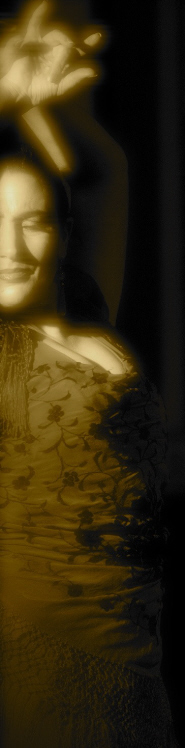
Women's dancing traditionally depends on the grace of the hands and body, rather than on footwork. Particularly in the BAILE GRANDE or profound dance, the arm, hand, and foot movements closely resemble those of classical Hindu dance. Gypsies began to dance professionally in cafés in the 19th century, and the word flamenco was first applied to their music and dance at this time.
Although earlier CANTES had been sung without guitar--as some varieties still are--in the cafés the guitar became prominent. Ideally the flamenco guitarist is a sensitive accompanist knowledgeable in the song and dance. In the café environment instrumental solos also became common, often departing from traditional forms. Essential to traditional flamenco is the DUENDE or possession of the performer by the unhampered emotion of the music or dance.
Performances are often accompanied by JALEO--intricate hand clapping, finger snapping, and encouraging shouts. Rhythms appropriate to the songs can also be performed as JALEO solos. Dancers frequently employ finger snapping in complex rhythms. Castanets, often associated with flamenco, were not part of the original Gypsy tradition.